Press notes
14 August 2026
What it is
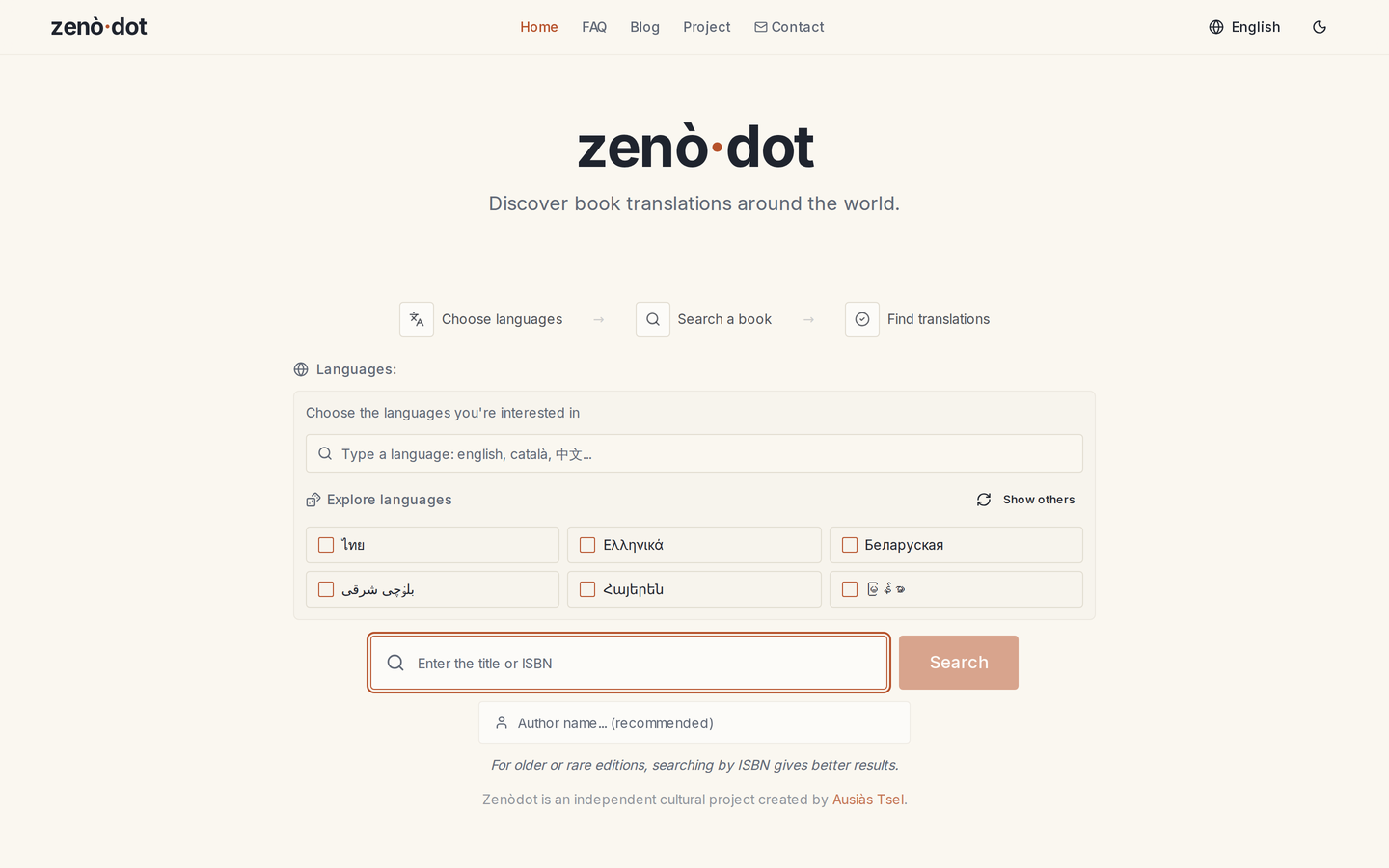
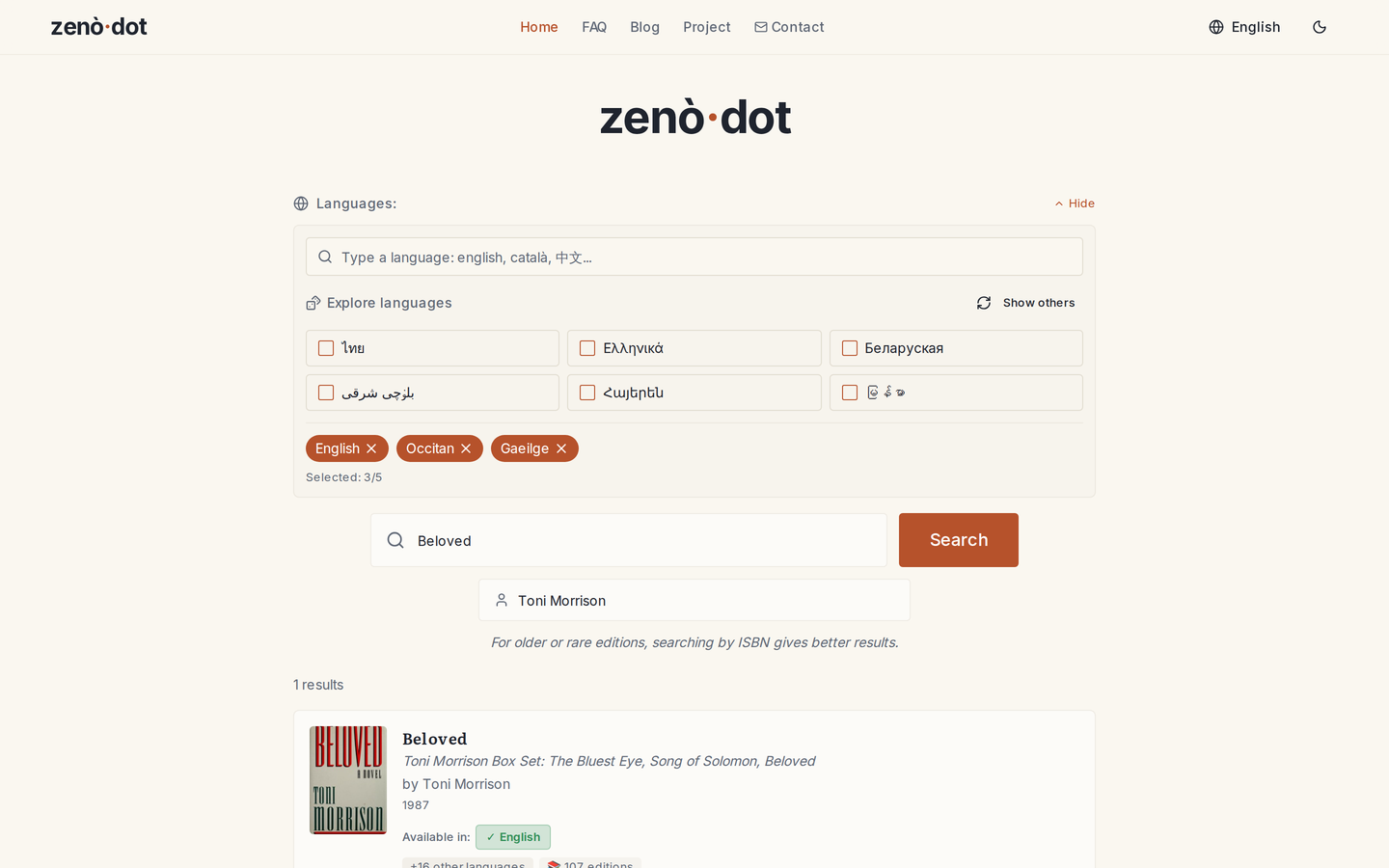
Zenòdot (zenodot.app) is the largest actively maintained open catalogue of book translations in the world — a free, independent canonical database of its own, built by correlating more than 50 open bibliographic sources with a matching engine of its own. It documents translations and editions across more than 800 languages, treating them all equally, with particular attention to languages minoritized in the publishing market.
Why it matters
The world's book infrastructure is built around a handful of major publishing languages: English, Spanish, Chinese, Russian, Arabic, French. A reader of one of those asks once whether a book exists in their language and gets an answer. Outside that handful the question turns hard even with a state behind the language — Danish and Icelandic readers meet the same wall — and for readers of minoritized languages it usually ends in a silence that cannot be told apart from a no. Zenòdot exists to make that answer, and just as often that absence, legible. Treating every language equally is not a feature of the tool; it is the reason it was built.
Who is behind it
Ausiàs Tsel, a writer from the Valencian Country. The project is solo-built and has no investors behind it. The public layer is free and will remain free.
Coverage
Coverage of Zenòdot to date. Any figures quoted in these pieces are the ones current on their date; the current ones are below.
- Lletraferit — «El projecte valencià Zenòdot cartografia les traduccions del món»23 August 2026 · feature
- Jane Friedman — «Zenòdot update: find works in translation»5 August 2026 · update · paid subscribers
- Nació Digital — «El català, entre les onze primeres llengües d'un catàleg mundial de 62 milions d'edicions»17 July 2026 · feature · by Laura Domingo
- The Europeans — «Do you also have a Monstera in your living room?»14 May 2026 · podcast
- À Punt Ràdio — «L'hora de la cultura»13 April 2026 · radio segment · 00:00–03:50
- Publishers Lunch — «Small Digital Delights»11 March 2026 · mention · by Michael Cader
- Jane Friedman — «Zenòdot: discover a book's translations worldwide»11 March 2026 · feature · paid subscribers
In the first person
- MIDAS — Eurac Research — «The catalogue never asked»24 August 2026 · essay · signed by Ausiàs Tsel
- LSE Impact Blog — «The missing catalogue – Why finding books in translation is still so hard»13 April 2026 · essay · signed by Ausiàs Tsel
Adoption in libraries
- University of Nevada, Las Vegas — University Libraries — «ENG 716, Translation (Chen)»5 March 2026 · course guide · listed alongside Index Translationum (UNESCO) and Publishers Weekly Translation Database
- California State University, Sacramento — University Library — «History (General) — Find Books»25 August 2026 · library guide
- Université de Montréal — Bibliothèque des lettres et sciences humaines — «Wikidata 101 — 1ère journée WikiSavoirs 2026»4 June 2026 · professional training session · listed alongside Scholia and OpenRefine
Key figures (verified)
- 820 languages with at least one documented edition, drawn from a base of over 234 million bibliographic records. On the stricter count, 802 of them hold catalogued editions.
- Around 65 million editions with a resolved language.
- More than 70 million author name variants (aliases), across scripts.
- More than 50 open sources: national-library catalogues from every continent.
- UNESCO's Index Translationum, released as open data in 2025, is folded in as one more source: 829,377 source records, each listing an original work and its translations, which unfold into 1.77 million editions in this catalogue. Carried forward with respect: not a successor, a continuation.
What it reveals
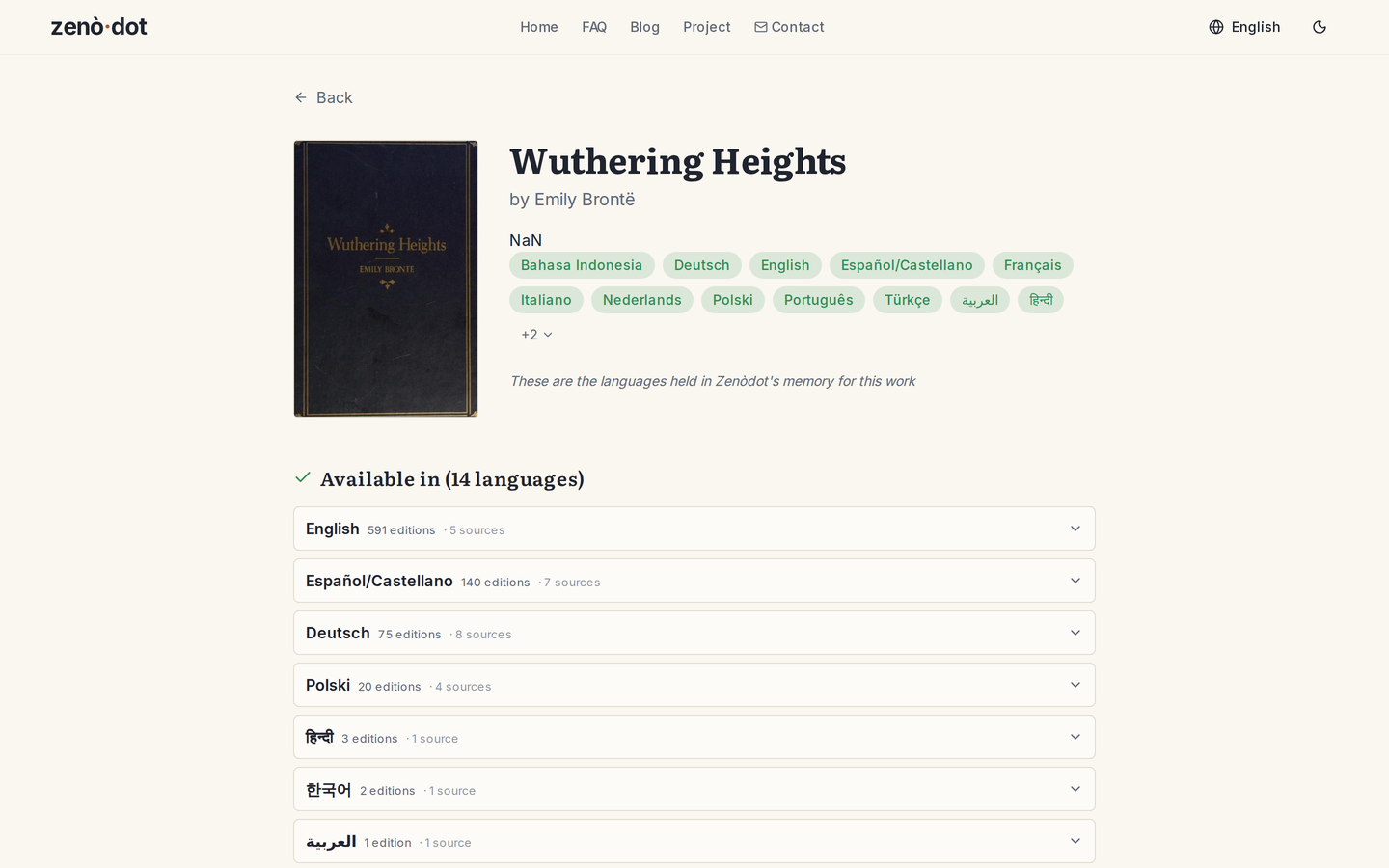
Once open catalogues are correlated, a large share of the translated backlist turns out to be catalogued somewhere yet invisible to readers, booksellers and libraries, especially for languages minoritized in the publishing market. Two examples at the level of a single work: Tirant lo Blanc, the fifteenth-century Valencian romance, gathers 468 catalogued editions, 259 of them in its own language; Mercè Rodoreda's La plaça del Diamant gathers 309.
Figures policy
All figures on this page are verified against the live corpus at the date above and updated with each revision of this page. Please cite figures from this page rather than from earlier coverage. Corrections and dated measurements cited by published articles are recorded in a dated, immutable method note at zenodot.app/press/method/2026-08.
Images


Share cards
Every book link shared from Zenòdot carries a live card: the original language first, then the languages where the work is documented — the smallest ones up front. On language pages where no edition is recorded, the card states the gap honestly. The images below are generated live from the catalogue and may be reused with attribution to zenodot.app.
Press contact
premsa@zenodot.app. Any questions are welcome at this address. Images on this page may be reused for coverage with attribution to zenodot.app.
Also available in: Español · Català/Valencià · Français